Pasek boczny artykułu
Treść głównego artykułu
Abstrakt
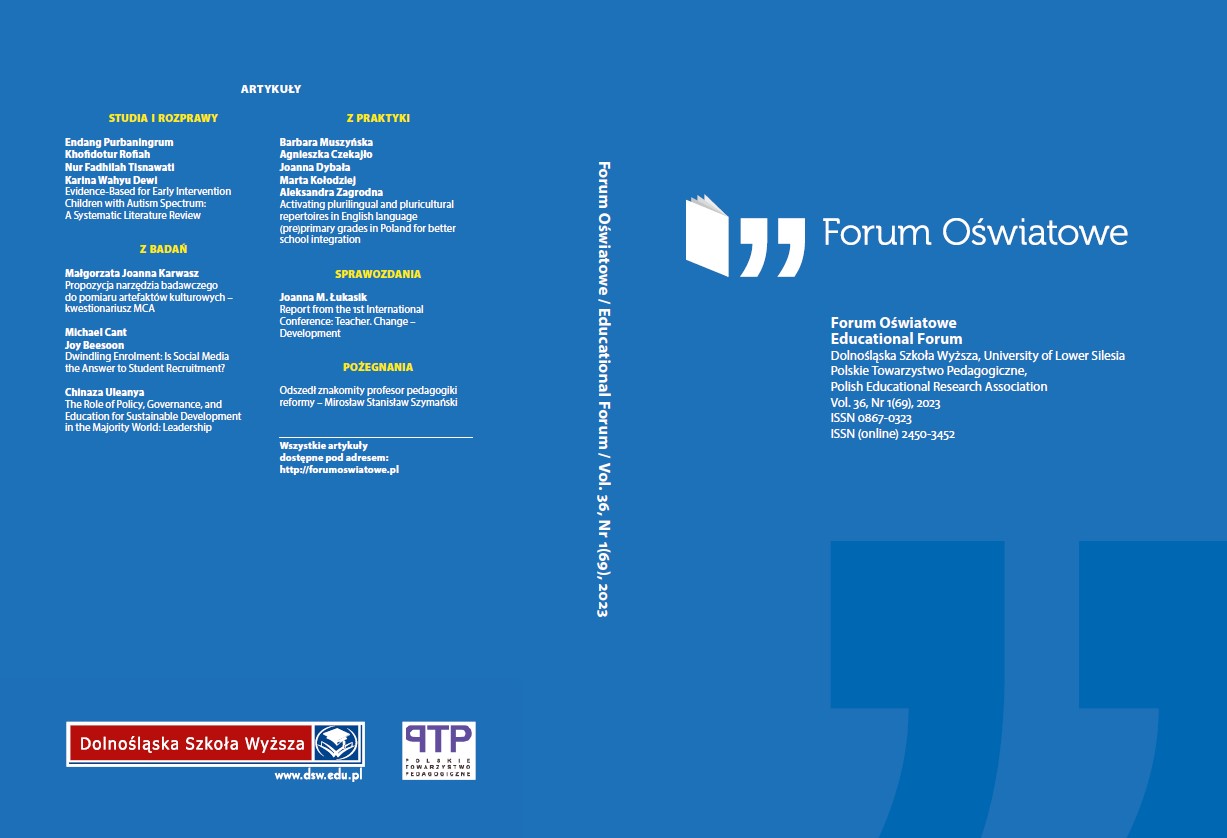
W ostatnich latach na całym świecie nasiliła się konkurencja między uniwersytetami w zakresie rekrutacji studentów. Wraz z coraz większą liczbą instytucji edukacyjnych wchodzących na rynek globalny, rywalizacja rekrutacyjna między tymi instytucjami nabrała nowego wymiaru. Zmusiło to uczelnie do wykorzystania wszelkich dostępnych środków, aby dotrzeć do potencjalnych studentów – w tym technologii i, co za tym idzie, mediów społecznościowych. Zarówno studenci, jak i uniwersytety mają swoje cele i oczekiwania, jeśli chodzi o korzystanie z mediów społecznościowych, dlatego istotne jest ustalenie zasad dotyczących korzystania z mediów społecznościowych podczas rekrutacji studentów. Głównym celem badania jest zatem zaproponowanie zestawu wytycznych, aby uniwersytety mogły skutecznie korzystać z mediów społecznościowych podczas rekrutacji studentów. Badanie zostało przeprowadzone na Mauritiusie, gdzie istnieje duża koncentracja instytucji szkolnictwa wyższego, tak, aby wyniki mogły zostać zaadaptowane przez inne uniwersytety ze względu na globalne wykorzystanie mediów społecznościowych. Jako badanie eksploracyjne, skupiono się na publicznych uniwersytetach na Mauritiusie. Spośród 49 497 studentów, którzy zarejestrowali się we wszystkich instytucjach szkolnictwa wyższego na Mauritiusie, 25 390 było zapisanych na cztery uniwersytety publiczne (Participation in Tertiary Education 2021, 2022:1). Wyraźnie wskazuje to na potrzebę odpowiedniego wykorzystania mediów społecznościowych przez uczelnie publiczne w celu dotarcia do potencjalnych studentów i pozyskania ich części z rynku. W badaniu zastosowano podejście jakościowe, które ma charakter eksploracyjny, z ośmioma administratorami uniwersytetów publicznych, z którymi przeprowadzono wywiady za pomocą częściowo ustrukturyzowanych wywiadów pogłębionych. Ponadto, 32 studentów pierwszego roku z uczelni publicznych wzięło udział w zogniskowanych dyskusjach grupowych. Zebrane dane zostały następnie poddane analizie tematycznej z wykorzystaniem procedury Brauna i Clarke’a. Wyniki badania wykazały, że na wszystkich publicznych uniwersytetach na Mauritiusie administratorzy stoją przed wyzwaniami związanymi z efektywnym wykorzystaniem mediów społecznościowych do rekrutacji studentów, głównie ze względu na fakt, że nie są pewni, z których platform i funkcji mediów społecznościowych korzystać; brakuje im umiejętności i zasobów do prowadzenia kampanii w mediach społecznościowych i nie są przeszkoleni w zakresie tworzenia ich treści. Z drugiej strony, potencjalni studenci wskazywali, że preferowaną przez nich platformą mediów społecznościowych jest Facebook. Stwierdzono również, że rodzaje informacji i treści, które studenci chcieliby uzyskać w mediach społecznościowych, obejmują między innymi porady dotyczące kariery, programu nauczania, oferowane kursy, warunki przyjęcia, opłaty, udogodnienia płatnicze oraz procedury. Na podstawie wyników badań zaproponowano zestaw wytycznych.
Słowa kluczowe
Szczegóły artykułu
Prawa autorskie (c) 2023 Forum Oświatowe

Utwór dostępny jest na licencji Creative Commons Uznanie autorstwa – Na tych samych warunkach 4.0 Miedzynarodowe.
Licencja
Osoba publikująca wyraża zgodę na udostępnianie utworu przez Dolnośląską Szkołę Wyższą na licencji Creative Commons Uznanie autorstwa – Na tych samych warunkach 4.0 Międzynarodowe, której pełny tekst dostępny jest na stronie internetowej: https://creativecommons.org/licenses/by-sa/4.0/legalcode
Osoba zgłaszająca upoważniona przez pozostałych współautorów do ich reprezentowania (autor korespondencyjny) zgłoszonego „utworu” oświadcza, że przysługują mu/jej autorskie prawa do utworu, które nie są ograniczone w zakresie objętym niniejszym oświadczeniem.
Utwór jest dziełem oryginalnym i nie narusza praw autorskich innych osób, ani nie jest ograniczony prawami na rzecz osób trzecich.
Utwór nie był wcześniej publikowany pod tym samym lub innym tytułem, nie stanowi również części innej publikacji. Utwór nie jest obecnie przedmiotem postępowania w innym wydawnictwie.
Osoba zgłaszająca utwór do publikacji w czasopiśmie „Forum Oświatowe” i tym samym potwierdza, że:
- Utwór został przygotowany zgodnie z zasadami edytorskimi obowiązującymi w czasopiśmie.
- Utwór zawiera informacje o źródłach finansowania badań, które stanowiły podstawę jego opracowania.
- Wyraża zgodę na przekazanie utworu do podwójnej recenzji, na podstawie której redakcja podejmie decyzję o przyjęciu lub odrzuceniu utworu do publikacji.
- Wyraża zgodę na dokonanie przez redakcję koniecznych zmian utworu wynikających z opracowania redakcyjnego.
- Zobowiązuje się do niezwłocznego dokonania korekty autorskiej utworu, po jego akceptacji przez redakcję. Niedokonanie korekty autorskiej w terminie 14 dni od daty otrzymania materiałów, traktowane będzie za zgodę na wydanie utworu w postaci przekazanej do korekty.
Osoba zgłaszająca udziela Dolnośląskiej Szkole Wyższej nieodpłatnej, nieograniczonej terytorialnie i czasowo nieodpłatnej licencji niewyłącznej na korzystanie z utworu pod warunkiem jego przyjęcia do opublikowania w czasopiśmie „Forum Oświatowe”, na następujących polach eksploatacji:
- Utrwalanie, zwielokrotnianie i wytwarzanie egzemplarzy utworu techniką drukarską, reprograficzną, zapisu magnetycznego oraz techniką cyfrową i zapisu elektronicznego.
- Obrotu oryginałem albo egzemplarzami, na których utwór utrwalono: wprowadzanie do obrotu, sprzedaż, użyczenie lub najem oryginału albo egzemplarzy, publiczne wystawienie, wyświetlenie, a także publiczne udostępnianie utworu w taki sposób, aby każdy mógł mieć do niego dostęp w miejscu i w czasie przez siebie wybranym, również w sieci Internet.
- Włączenie utworu w skład utworu zbiorowego.
- Tłumaczenia na inne języki i rozpowszechniania tych tłumaczeń.
Publikujemy zgodnie z zaleceniami The Committee on Publication Ethics (COPE), w wolnym dostępie na licencji Creative Commons Uznanie autorstwa – Na tych samych warunkach 4.0 Międzynarodowe.
Referencje
- Adu, P. (2019). A Step-by-Step Guide to Qualitative Data Coding (1st ed.). Routledge. https://doi.org/10.4324/9781351044516. DOI: https://doi.org/10.4324/9781351044516-1
- Aichner, T., Grünfelder, M., Maurer, O., & Jegeni, D. (2021). Twenty-Five Years of Social Media: A Review of Social Media Applications and Definitions from 1994to 2019. In Cyberpsychology, Behavior, and Social Networking (Vol. 24, Issue 4, pp.215–222). Mary Ann Liebert Inc. https://doi.org/10.1089/cyber.2020.0134. DOI: https://doi.org/10.1089/cyber.2020.0134
- Ait Lamkadem, S., & Ouiddad, S. (2021). Towards creating an effective customer brand engagement through social media marketing: A model proposal. International Journal of Business and Management Invention (IJBMI) ISSN, 10, 28–36. https://doi.org/10.35629/8028-1004012836.
- Al-Thagafi, A., Mannion, M. and Siddiqui, N., 2020. Digital marketing for Saudi Arabian university student recruitment. Journal of Applied Research in Higher Education, 12(5), pp.1147-1159.
- Arifin, Z.A.L.S., Sumarwan, U & Najib, M. (2020). The Influence of Marketing Mix on Brand Image, Motivation and Students Decision to Choose Graduate Studies of IPB University. Journal of Consumer Sciences.Vol. 05, No. 02, 139-156. DOI: https://doi.org/10.29244/jcs.5.2.139-156
- Aririguzoh, S. (2020). Making a Christian Private University Appealing to Prospective Students: The Case of Covenant University. In: Mogaji, E., Maringe, F., Ebo Hinson, R. (eds) Higher Education Marketing in Africa. Palgrave Macmillan, Cham. https://doi.org/10.1007/978-3-030-39379-3_14. DOI: https://doi.org/10.1007/978-3-030-39379-3_14
- Arora, A., Jain, J, Gupta, S. & Sharma, A. (2020). Identifying sustainability drivers in higher education through fuzzy AHP. Higher Education, Skills and Work-Based Learning. https://doi.org/10.1108/HESWBL-03-2020-0051. DOI: https://doi.org/10.1108/HESWBL-03-2020-0051
- Babaitsev, A.V., Mikova, E.A., Kosyanenko, E.V., Podoprigora, A.S. (2020). Using Information and Communication Technologies in University Marketing: Local Features. Advances in Social Science, Education and Humanities Research, volume 437. https://dx.doi.org/10.2991/assehr.k.200509.099. DOI: https://doi.org/10.2991/assehr.k.200509.099
- Barnard, S. M., Bothma, C. H., & Cant, M. C. (2017). The identification of criteria for the optimal use of Facebook pages for marketing purposes: a South African perspective. In www.jbrmr.com A Journal of the Academy of Business and Retail Management (Vol. 11, Issue 2). ABRM. www.jbrmr.com.
- Barnard, S. M., Bothma, C. H., & Cant, M. C. (2017). The identification of criteria for the optimal use of Facebook pages for marketing purposes: a South African perspective. In www.jbrmr.com A Journal of the Academy of Business and Retail Management (Vol. 11, Issue 2). ABRM. www.jbrmr.com.
- Boyd, D.M. & Ellison, N. B. 2007. “Social Network Sites: Definition, History, and Scholarship,” Journal of Computer-Mediated Communication (13:1), pp. 210-230. DOI: https://doi.org/10.1111/j.1083-6101.2007.00393.x
- Braun V., Clarke V., Hayfield N., Terry G. (2019) Thematic Analysis. In: Liamputtong P. (ed) Handbook of Research Methods in Health Social Sciences. Springer, Singapore. https://doi.org/10.1007/978-981-10-5251-4_103. DOI: https://doi.org/10.1007/978-981-10-5251-4_103
- Braun, V. & Clarke, V. (2020): One size fits all? What counts as quality practice in (reflexive) thematic analysis?, Qualitative Research in Psychology, DOI:10.1080/14780887.2020.1769238. DOI: https://doi.org/10.1080/14780887.2020.1769238
- Braun, V., & Clarke, V. (2006). Using thematic analysis in psychology. Qualitative Research in Psychology, 3(2), 77-101. https://doi.org/10.1191/1478088706qp063oa DOI: https://doi.org/10.1191/1478088706qp063oa
- Cant, M.C. (2016). Using social media to market a promotional event to SMEs: opportunity or wasted effort?. Problems and Perspectives in Management,14(4), 76-82. doi:10.21511/ppm.14(4).2016.09. DOI: https://doi.org/10.21511/ppm.14(4).2016.09
- Capriotti, P., Zeler, I., & Camilleri, M. A. (2021). Corporate Communication Through Social Networks: The Identification of the Key Dimensions for Dialogic Communication. In Strategic Corporate Communication in the Digital Age (pp. 33–51). Emerald Publishing Limited. https://doi.org/10.1108/978-1-80071-264-520211003. DOI: https://doi.org/10.1108/978-1-80071-264-520211003
- Carr, C.T. and Hayes, R.A. (2015), “Social media: defining, developing, and divining”, Atlantic Journal of Communication, Vol. 23 No. 1, pp. 46-65. DOI: https://doi.org/10.1080/15456870.2015.972282
- Chan Sun, M. & Lan Cheong Wah, C.B. (2020). Lessons to be learnt from the COVID-19 public health response in Mauritius. Public Health in Practice. Available online from https://www.sciencedirect.com/science/article/pii/S2666535220300227. Accessed on 15 September 2020. https://doi.org/10.1016/j.puhip.2020.100023/. DOI: https://doi.org/10.1016/j.puhip.2020.100023
- Chankseliani, M., Qoraboyev, I., & Gimranova, D. (2021). Higher education contributing to local, national, and global development: new empirical and conceptual insights. Higher Education, 81(1), 109–127. https://doi.org/10.1007/s10734-020-00565-8. DOI: https://doi.org/10.1007/s10734-020-00565-8
- Chapleo, C. and O’Sullivan, H., 2017. Contemporary thought in higher education marketing. Journal of Marketing for Higher Education, 27 (2), 159-161.Chen & DiVall (2019). Social Media as an Engagement Tool for Schools and Colleges of Pharmacy. American Journal of Pharmaceutical Education. 82 (4) Article 6562. DOI: https://doi.org/10.5688/ajpe6562
- Chung, C. H., Chiu, D. K. W., Ho, K. K. W., & Au, C. H. (2020). Applying social media to environmental education: is it more impactful than traditional media? Information Discovery and Delivery, 48(4), 255–266. https://doi.org/10.1108/IDD-04-2020-0047. DOI: https://doi.org/10.1108/IDD-04-2020-0047
- Condie, Ayodele, Chowdhury, Powe & Cooper (2018): Personalizing Twitter communication: an evaluation of ‘rotation-curation’for enhancing social media engagement within higher education, Journal of Marketing for Higher Education, DOI: 10.1080/08841241.2018.1453910. DOI: https://doi.org/10.1080/08841241.2018.1453910
- Dennis, M.J (2020). What needs to change in the reimagined university? University World News. [Online]. Accessed on 21 September 2020. Available from https://www.universityworldnews.co/post.php?story=20200918114611781.
- DeSantis L, Ugarriza DN. The Concept of Theme as Used in Qualitative Nursing Research. Western Journal of Nursing Research. 2000;22(3):351-372.doi:10.1177/019394590002200308. DOI: https://doi.org/10.1177/019394590002200308
- Devetyarova, I. P., Agalakova, O. S., Cheglakova, L. S., & Kolesova, Y. A. (2020). Institutionalization of successful marketing practices of digital universities based on quality management in modern russia. International Journal for Quality Research, 14(2), 523–542. https://doi.org/10.24874/ijqr14.02-12. DOI: https://doi.org/10.24874/IJQR14.02-12
- Digital Marketing Institute (2019). “The Importance of Social Media in Higher Education.” [Online]. Accessed on 13 July 2019. Available from: https://digitalmarketinginstitute.com/blog/06-03-18-the-importance-of-socialmedia-in-highereducation.
- Dolan, R., Conduit, J., Fahy, J. & Goodman, S. (2017) “Social media: communication strategies, engagement and future research directions”, International Journal of Wine Business Research, Vol. 29 Issue: 1, pp.2-19, https://doi.org/10.1108/IJWBR-04-2016-0013. DOI: https://doi.org/10.1108/IJWBR-04-2016-0013
- Effing, R.& Spil, T.A.M (2015). The social strategy cone: Towards a framework for evaluating social media strategies. International Journal of Information Management.36.1-8. DOI: https://doi.org/10.1016/j.ijinfomgt.2015.07.009
- Enache, I.C. (2011): Marketing higher education using the 7Ps framework. Bulletin of the Transilvania University of Braşov, 4(1), 23–30. Farinloye, T., Wayne,T. Mogaji, E. & Watat, J.K. (2020). Marketisation in African
- Universities in an era of decolonisation. In Mogaji, E., Maringe, F. & Hinson, R.E. (Eds.) Strategic Marketing of Higher Education in Africa.Routledge, New York.
- Gashi, R., & Ahmeti, H. G. (2021). Impact of social media on the development of new products, marketing and customer relationship management in Kosovo. Emerging Science Journal, 5(2), 125–138. https://doi.org/10.28991/esj-2021-01263. DOI: https://doi.org/10.28991/esj-2021-01263
- Gök, E., & Gümüş, S. (2018). International student recruitment efforts of Turkish Universities: Rationales and strategies. In International Perspectives on Education and Society (Vol. 34, pp. 231–255). Emerald Group Publishing Ltd. https://doi.org/10.1108/S1479-367920180000034019. DOI: https://doi.org/10.1108/S1479-367920180000034019
- Gordon-Isasi, J., Narvaiza, L., & Gibaja, J. J. (2021). Revisiting integrated marketing communication (IMC): a scale to assess IMC in higher education (HE). Journal of Marketing for Higher Education, 31(1), 58–90. https://doi.org/10.1080/08841241.2020.1758283. DOI: https://doi.org/10.1080/08841241.2020.1758283
- Gunina, D., Komárková, L., & Přibyl, V. (2019). How to attract university applicants: exploring tertiary education advertising patterns in the Czech Republic. Tertiary Education and Management, 25(4), 349–366. https://doi.org/10.1007/s11233-019-09038-9.
- Gunina, D., Komárková, L., & Přibyl, V. (2019). How to attract university applicants:exploring tertiary education advertising patterns in the Czech Republic. Tertiary Education and Management, 25(4), 349–366. https://doi.org/10.1007/s11233-019-09038-9. DOI: https://doi.org/10.1007/s11233-019-09038-9
- Hannan, S. (2021). Building a Brand in Higher Education: A Review of the Literature on Higher Education Institutions Brand Management.
- Harb, Deborah Fowler, Hyo Jung (Julie) Chang, Shane C. Blum, Wejdan Alakaleek (2019) “Social media as a marketing tool for events,” Journal of Hospitality and Tourism Technology, Vol. 10 Issue: 1, pp.28-44, https://doi.org/10.1108/JHTT-03-2017-0027. DOI: https://doi.org/10.1108/JHTT-03-2017-0027
- Harper, D. J., & Harrison, L. M. (2020). Ethical Leadership in Higher Education: Responding to the Rise of For-Profit Education in the United States (pp. 127–139).https://doi.org/10.1108/s2055-364120200000024012 DOI: https://doi.org/10.1108/S2055-364120200000024012
- Huebner, C. (2021). Admissions and advertising: Students’ perception of social media advertising as a recruiting tool. Journal of Digital and Social Media Marketing, 8(4). DOI: https://doi.org/10.69554/LARO4682
- Ilieva, J. & Raimo, V. (2020). Challenges of student recruitment in the age of COVID-19. University World News. [Online]. Available from https://www.universityworldnews.com/post.php?story=20200327082653290. Accessed on 19 September 2020.
- James-MacEachern, M. (2018). A comparative study of international recruitment – tensions and opportunities in institutional recruitment practice. Journal of Marketing for Higher Education. DOI: 10.1080/08841241.2018.1471014. DOI: https://doi.org/10.1080/08841241.2018.1471014
- Kaplan, A.M., Haenlein, M., (2010). Users of the world, unite! The challenges and opportunities of Social Media. Business Horizons. 53. 59—68. DOI: https://doi.org/10.1016/j.bushor.2009.09.003
- Keles, B. Niall McCrae & Annmarie Grealish (2020) A systematic review: the influence of social media on depression, anxiety and psychological distress in adolescents, International Journal of Adolescence and Youth, 25:1, 79-93, DOI: 10.1080/02673843.2019.1590851. DOI: https://doi.org/10.1080/02673843.2019.1590851
- Kent, M. (2015). Social Media Circa 2035: Directions in Social Media Theory (Vol. 23). https://doi.org/10.1080/15456870.2015.972407 DOI: https://doi.org/10.1080/15456870.2015.972407
- Kumar, V., & Nanda, P. (2019). Social media in higher education: A framework for continuous engagement. International Journal of Information and Communication Technology Education, 15(1), 109–120. https://doi.or/10.4018/IJICTE.2019010108. DOI: https://doi.org/10.4018/IJICTE.2019010107
- Ladokun, I. O. (2019). Exploring Social Media as a Strategy for Small and Medium Enterprises (SMEs) Performance: Evidence from Oyo State, Nigeria. South Asian Journal of Social Studies and Economics. https://doi.org/10.9734/sajsse/2019/v3i430110. DOI: https://doi.org/10.9734/sajsse/2019/v3i430110
- Leung, M. (2022). Student anger over lockdowns still fuels sporadic protests. University World News [Online]. Accessed on 20 December 2022. Available from https://www.universityworldnews.com/post.php?story=20221209070807431.
- Ling, L. (2020). Universities and research in times of crisis: the getting of wisdom. Qualitative Research Journal. 1443-9883. DOI 10.1108/QRJ-06-2020-0055 DOI: https://doi.org/10.1108/QRJ-06-2020-0055
- Lukić, V.R, Lukić, N (2016). Application of marketing mix concept in student recruitment strategies: evidence from University of Novi of Sad, Serbia. Journal of Marketing for Higher Education. Vol. 13, № 3 2016: 183-202. DOI: https://doi.org/10.5937/MegRev1603183R
- Makwinja, V. M. (2020). Inclusive and Multicultural Education: The Dynamics of Higher Education Institutions in Botswana – Inequality and Exclusion of Students (pp. 85–99). https://doi.org/10.1108/s2055-364120200000030007. DOI: https://doi.org/10.1108/S2055-364120200000030007
- Malesev, S., & Cherry, M. (2021). Digital and social media marketing-growing market share for construction smes. Construction Economics and Building, 21(1). https://doi.org/10.5130/AJCEB.v21i1.7521.
- Malesev, S., & Cherry, M. (2021). Digital and social media marketing-growing market share for construction smes. Construction Economics and Building, 21(1). https://doi.org/10.5130/AJCEB.v21i1.7521. DOI: https://doi.org/10.5130/AJCEB.v21i1.7521
- Maringe, F. & Ndofirepi, E.S. (2018). Sustainable transformation of doctoral training in African Universities. Sustainable Transformation in African HigherEducation. DOI: https://doi.org/10.1007/978-94-6300-902-7_4
- Maringe, F. & Ojo, E. (Eds.). Sense Publishers, AW Rotterdam, Netherlands.
- Marinoni, G.; van’t Land, H. & Jensen, T. (2020). The Impact of Covid-19 on Higher Education Around the World. IAU Global Survey Report.[Online]. Available from https://www.iau-aiu.net/IMG/pdf/iau_covid19_and_he_survey_report_final_may_2020.pdf . Accessed on 20 September 2020.
- Marinoni, G., Land, H.V., and Jensen, T. (2020).”The Impact of Covid-19 on Higher Education around the World. IAU Global Survey Report.” https://www.iau-aiu.net/IMG/pdf/iau_covid19_and_he_survey_report_final_may_2020.pdf
- Mazurek, G., Korzyński, P., & Górska, A. (2019). Social Media in the Marketing of Higher Education Institutions in Poland: Preliminary Empirical Studies. Entrepreneurial Business and Economics Review, 7(1), 117-133. https://doi.org/10.15678/EBER.2019.070107. DOI: https://doi.org/10.15678/EBER.2019.070107
- Mitchell, N. (2020). European HE systems predict post-COVID funding squeeze. University World News. [Online]. Available from https://www.universityworldnews.com/post.php?story=20200924162420561 Accessed on 24 November 2022.
- Mogaji, E. (Ed.), Maringe, F. (Ed.), Hinson, R. (Ed.). (2020). Strategic Marketing of Higher Education in Africa. London: Routledge, https://doi.org/10.4324/9780429320934 DOI: https://doi.org/10.4324/9780429320934
- Mogaji, E., & Yoon, H. (2019). Thematic analysis of marketing messages in UK universities’ prospectuses. International Journal of Educational Management, 33(7),1561–1581. https://doi.org/10.1108/IJEM-05-2018-0149. DOI: https://doi.org/10.1108/IJEM-05-2018-0149
- Momunalieva, A., Urdaletova, A., Ismailova, R., & Abdykeev, E. (2020). The quality of higher education in Kyrgyzstan through the eyes of students. Quality in Higher Education, 26(3), 337–354. https://doi.org/10.1080/13538322.2020.1790122. DOI: https://doi.org/10.1080/13538322.2020.1790122
- Mwenda, A.B, Sullivan, M. & Grand, A. (2019): How do Australian universities market STEM courses in YouTube videos? Journal of Marketing for Higher Education. DOI: 10.1080/08841241.2019.1633004. DOI: https://doi.org/10.1080/08841241.2019.1633004
- Navarro, C., Moreno, M., Zerfass, A. (2018).”Mastering the dialogic tools: Social media use and perceptions of public relations practitioners in Latin America”, Journal of Communication Management, Vol. 22 Issue: 1, pp.28-45, https://doi.org/10.1108/JCOM-12-2016-0095. DOI: https://doi.org/10.1108/JCOM-12-2016-0095
- Nevzat, R., Amca, Y., Tanova, C. & Amca, H. (2016). Role of social media community in strengthening trust and loyalty for a university. Computers in Human Behavior. 65. 550e559. DOI: https://doi.org/10.1016/j.chb.2016.09.018
- Newton-Levinson, A, Leichliter, J.S., Chandra-Mouli, V. (2016). Sexually Transmitted Infection Services for Adolescents and Youth in Low- and Middle-Income Countries: Perceived and Experienced Barriers to Accessing Care. Journal of Adolescent Health. Volume 59, Issue 1. DOI: https://doi.org/10.1016/j.jadohealth.2016.03.014
- Nicolescu, L. (2009). Applying Marketing to Higher Education: Scope and Limits. Management & Marketing. Vol. 4, No. 2, pp. 35-44
- Nikhlis, N., Iriani, A., & Hartomo, K. D. (2020). Soft System Methodology (SSM) Analysis to Increase the Number of Prospective Students. INTENSIF: Jurnal Ilmiah Penelitian Dan Penerapan Teknologi Sistem Informasi, 4(1). https://doi.org/10.29407/intensif.v4i1.13552 DOI: https://doi.org/10.29407/intensif.v4i1.13552
- Nowell, L. S., Norris, J. M., White, D. E., & Moules, N. J. (2017). Thematic Analysis: Striving to Meet the Trustworthiness Criteria. International Journal of Qualitative Methods, 16(1). https://doi.org/10.1177/1609406917733847
- Nowell, L.S, Norris, J.M., White, D.E. & Moules, N.J. (2016). Thematic Analysis: Striving to Meet the Trustworthiness Criteria. International Journal of Qualitative Methods. Volume 16: 1–13. DOI: https://doi.org/10.1177/1609406917733847
- Nwedu, C.N. (2019). Strategies and Opportunities for Student Recruitment and Retention in African. Journal of Educational and Psychological Research. Volume 1.Issue 2.1-9. Universities: Lessons from Western Universities. DOI: https://doi.org/10.33140/JEPR.01.02.04
- Oliveira, L. G. (2020). A framework for the development of social media content strategies for higher education institutions. Estudos Em Comunicacao, 30, 21–48. https://doi.org/10.25768/20.04.03.30.02
- Oliveira, L. G. (2020). A framework for the development of social media content strategies for higher education institutions. Estudos Em Comunicacao, 30, 21–48. https://doi.org/10.25768/20.04.03.30.02.
- Onuka, A.O.U (2018). Sustainable Transformation in African Higher Education. Maringe & Ojo (Eds.). Sense Publishers, AW Rotterdam, The Netherlands.
- Panagiotopoulos, P., Shan, L.C., Barnett, J.,Regan,A. & McConnon, A. (2015). A framework of social media engagement: Case studies with food and consumer organisations in the UK and Ireland. Journal of Information Management. 35.394-402.
- Pantano, E., Priporas, C.V & Migliano, G (2019). “Reshaping traditional marketing mix to include social media participation: evidence from Italian firms,” European Business Review, https://doi.org/10.1108/EBR-08-2017-0152. DOI: https://doi.org/10.1108/EBR-08-2017-0152
- Participation in Tertiary Education 2020. (2021). Higher Education Commission. [Online]. Accessed on 03 August 2022. Available from https://www.hec.mu/pdf_downloads/rpldivision/Participation2020.pdf.
- Participation in Tertiary Education 2021, (2022). Higher Education Commission [Online]. Accessed on 17 December 2022. Available from https://www.hec.mu/pdf_downloads/rpldivision/Participation_in_Tertiary_Education_2021.pdf.
- Peruta, A. & Shields, A.B. (2017) Social media in higher education: understanding how colleges and universities use Facebook, Journal of Marketing for Higher Education, 27:1, 131-143, DOI: 10.1080/08841241.2016.1212451. DOI: https://doi.org/10.1080/08841241.2016.1212451
- Rey-Garcia, M. & Mato-Santiso, V. (2020). Enhancing the effects of university education for sustainable development on social sustainability: the role of social capital and real-world learning. International Journal of Sustainability in Higher Education. 1467-6370. DOI 10.1108/IJSHE-02-2020-0063. DOI: https://doi.org/10.1108/IJSHE-02-2020-0063
- Al-Thagafi, A., Mannion, M. & Siddiqui, N. (2019). Digital marketing for Saudi Arabian university student recruitment. Journal of Applied Research in Higher Education.DOI 10.1108/JARHE-05-2019-0119 DOI: https://doi.org/10.1108/JARHE-05-2019-0119
- Setiawan, R., Pio, L., Cavaliere, L., Hussaini, T., Orlando Villalba-Condori, K., Arias-Chavez, D., Gupta, M., Untari, T., & Regin, R. (2020). The Impact of Educational Marketing on Universities Performance. In Original (Vol. 25, Issue 5). GITO Verlag.
- Shields, A. B., & Peruta, A. (2019). Social media and the university decision. Do prospective students really care? Journal of Marketing for Higher Education, 29(1).https://doi.org/10.1080/08841241.2018.1557778 DOI: https://doi.org/10.1080/08841241.2018.1557778
- Shneikat, B. (2021). The Future of International Student Recruitment. In Global Perspectiveson Recruiting International Students: Challenges and Opportunities (pp.245–256). Emerald Publishing Limited. https://doi.org/10.1108/978-1-83982-518-720211016. DOI: https://doi.org/10.1108/978-1-83982-518-720211016
- Son-Turan, S. (2021). The HESFS for higher education funding, employment and sustainability. International Journal of Sustainability in Higher Education, 22(1),100–119. https://doi.org/10.1108/IJSHE-10-2019-0310 DOI: https://doi.org/10.1108/IJSHE-10-2019-0310
- Statista (2022). Most popular social networks worldwide as of July 2021, ranked by number of active users. [Online]. Accessed on 17 December 2022. Available from https://www.statista.com/statistics/272014/global-social-networks-ranked-bynumber-of-users/.
- Ürer Erdil, D., Tümer, M., Nadiri, H., & Aghaei, I. (2021). Prioritizing Information Sources and Requirements in Students’ Choice of Higher Education Destination: Using AHP Analysis. SAGE Open, 11(2). https://doi.org/10.1177/21582440211015685. DOI: https://doi.org/10.1177/21582440211015685
- Valerio-Ureña, G., Herrera-Murillo, D., & Madero-Gómez, S. (2020). Analysis of the presence of most best-ranked universities on social networking sites. Informatics, 7(1). https://doi.org/10.3390/informatics7010009. DOI: https://doi.org/10.3390/informatics7010009
- Valos, M.J., Habibi, F.H.,Casidy, R., Driesener, C.B. & Maplestone, V.L. (2016) “Exploring the integration of social media within integrated marketing communication frameworks: Perspectives of services marketers”, Marketing Intelligence & Planning, Vol. 34 Issue: 1, pp.19-40, https://doi.org/10.1108/MIP-09-2014-0169 DOI: https://doi.org/10.1108/MIP-09-2014-0169
- Vrontis, D., El Nemar, S., Ouwaida, A. &Shams, S.M.R (2018) “The impact of social media on international student recruitment: the case of Lebanon,” Journal of International Education in Business, Vol. 11 Issue: 1, pp.79- DOI: https://doi.org/10.1108/JIEB-05-2017-0020
- Wong, L. W., Tan, G. W. H., Hew, J. J., Ooi, K. B., & Leong, L. Y. (2022). Mobile social media marketing: a new marketing channel among digital natives in higher education? Journal of Marketing for Higher Education, 32(1), 113–137. https://doi.org/1 0.1080/08841241.2020.1834486
- Wong, P., Lee, D., & M.L. Ng, P. (2018). Online search for information about universities: a Hong Kong study. International Journal of Educational Management, 32(3), 511–524. https://doi.org/10.1108/IJEM-12-2016-0268. DOI: https://doi.org/10.1108/IJEM-12-2016-0268
- Yang, H. P., Yen, D., & Balmer, J. M. T. (2020). Higher education: a once-in-a-lifetime purchase. Qualitative Market Research, 23(4), 865–890. https://doi.org/10.1108/QMR-12-2017-0169. DOI: https://doi.org/10.1108/QMR-12-2017-0169
- Zhu, Y. (2019): Social media engagement and Chinese international student recruitment: understanding how UK HEIs use Weibo and WeChat, Journal of Marketing for Higher Education, DOI: 10.1080/08841241.2019.1633003. DOI: https://doi.org/10.1080/08841241.2019.1633003
Referencje
Adu, P. (2019). A Step-by-Step Guide to Qualitative Data Coding (1st ed.). Routledge. https://doi.org/10.4324/9781351044516. DOI: https://doi.org/10.4324/9781351044516-1
Aichner, T., Grünfelder, M., Maurer, O., & Jegeni, D. (2021). Twenty-Five Years of Social Media: A Review of Social Media Applications and Definitions from 1994to 2019. In Cyberpsychology, Behavior, and Social Networking (Vol. 24, Issue 4, pp.215–222). Mary Ann Liebert Inc. https://doi.org/10.1089/cyber.2020.0134. DOI: https://doi.org/10.1089/cyber.2020.0134
Ait Lamkadem, S., & Ouiddad, S. (2021). Towards creating an effective customer brand engagement through social media marketing: A model proposal. International Journal of Business and Management Invention (IJBMI) ISSN, 10, 28–36. https://doi.org/10.35629/8028-1004012836.
Al-Thagafi, A., Mannion, M. and Siddiqui, N., 2020. Digital marketing for Saudi Arabian university student recruitment. Journal of Applied Research in Higher Education, 12(5), pp.1147-1159.
Arifin, Z.A.L.S., Sumarwan, U & Najib, M. (2020). The Influence of Marketing Mix on Brand Image, Motivation and Students Decision to Choose Graduate Studies of IPB University. Journal of Consumer Sciences.Vol. 05, No. 02, 139-156. DOI: https://doi.org/10.29244/jcs.5.2.139-156
Aririguzoh, S. (2020). Making a Christian Private University Appealing to Prospective Students: The Case of Covenant University. In: Mogaji, E., Maringe, F., Ebo Hinson, R. (eds) Higher Education Marketing in Africa. Palgrave Macmillan, Cham. https://doi.org/10.1007/978-3-030-39379-3_14. DOI: https://doi.org/10.1007/978-3-030-39379-3_14
Arora, A., Jain, J, Gupta, S. & Sharma, A. (2020). Identifying sustainability drivers in higher education through fuzzy AHP. Higher Education, Skills and Work-Based Learning. https://doi.org/10.1108/HESWBL-03-2020-0051. DOI: https://doi.org/10.1108/HESWBL-03-2020-0051
Babaitsev, A.V., Mikova, E.A., Kosyanenko, E.V., Podoprigora, A.S. (2020). Using Information and Communication Technologies in University Marketing: Local Features. Advances in Social Science, Education and Humanities Research, volume 437. https://dx.doi.org/10.2991/assehr.k.200509.099. DOI: https://doi.org/10.2991/assehr.k.200509.099
Barnard, S. M., Bothma, C. H., & Cant, M. C. (2017). The identification of criteria for the optimal use of Facebook pages for marketing purposes: a South African perspective. In www.jbrmr.com A Journal of the Academy of Business and Retail Management (Vol. 11, Issue 2). ABRM. www.jbrmr.com.
Barnard, S. M., Bothma, C. H., & Cant, M. C. (2017). The identification of criteria for the optimal use of Facebook pages for marketing purposes: a South African perspective. In www.jbrmr.com A Journal of the Academy of Business and Retail Management (Vol. 11, Issue 2). ABRM. www.jbrmr.com.
Boyd, D.M. & Ellison, N. B. 2007. “Social Network Sites: Definition, History, and Scholarship,” Journal of Computer-Mediated Communication (13:1), pp. 210-230. DOI: https://doi.org/10.1111/j.1083-6101.2007.00393.x
Braun V., Clarke V., Hayfield N., Terry G. (2019) Thematic Analysis. In: Liamputtong P. (ed) Handbook of Research Methods in Health Social Sciences. Springer, Singapore. https://doi.org/10.1007/978-981-10-5251-4_103. DOI: https://doi.org/10.1007/978-981-10-5251-4_103
Braun, V. & Clarke, V. (2020): One size fits all? What counts as quality practice in (reflexive) thematic analysis?, Qualitative Research in Psychology, DOI:10.1080/14780887.2020.1769238. DOI: https://doi.org/10.1080/14780887.2020.1769238
Braun, V., & Clarke, V. (2006). Using thematic analysis in psychology. Qualitative Research in Psychology, 3(2), 77-101. https://doi.org/10.1191/1478088706qp063oa DOI: https://doi.org/10.1191/1478088706qp063oa
Cant, M.C. (2016). Using social media to market a promotional event to SMEs: opportunity or wasted effort?. Problems and Perspectives in Management,14(4), 76-82. doi:10.21511/ppm.14(4).2016.09. DOI: https://doi.org/10.21511/ppm.14(4).2016.09
Capriotti, P., Zeler, I., & Camilleri, M. A. (2021). Corporate Communication Through Social Networks: The Identification of the Key Dimensions for Dialogic Communication. In Strategic Corporate Communication in the Digital Age (pp. 33–51). Emerald Publishing Limited. https://doi.org/10.1108/978-1-80071-264-520211003. DOI: https://doi.org/10.1108/978-1-80071-264-520211003
Carr, C.T. and Hayes, R.A. (2015), “Social media: defining, developing, and divining”, Atlantic Journal of Communication, Vol. 23 No. 1, pp. 46-65. DOI: https://doi.org/10.1080/15456870.2015.972282
Chan Sun, M. & Lan Cheong Wah, C.B. (2020). Lessons to be learnt from the COVID-19 public health response in Mauritius. Public Health in Practice. Available online from https://www.sciencedirect.com/science/article/pii/S2666535220300227. Accessed on 15 September 2020. https://doi.org/10.1016/j.puhip.2020.100023/. DOI: https://doi.org/10.1016/j.puhip.2020.100023
Chankseliani, M., Qoraboyev, I., & Gimranova, D. (2021). Higher education contributing to local, national, and global development: new empirical and conceptual insights. Higher Education, 81(1), 109–127. https://doi.org/10.1007/s10734-020-00565-8. DOI: https://doi.org/10.1007/s10734-020-00565-8
Chapleo, C. and O’Sullivan, H., 2017. Contemporary thought in higher education marketing. Journal of Marketing for Higher Education, 27 (2), 159-161.Chen & DiVall (2019). Social Media as an Engagement Tool for Schools and Colleges of Pharmacy. American Journal of Pharmaceutical Education. 82 (4) Article 6562. DOI: https://doi.org/10.5688/ajpe6562
Chung, C. H., Chiu, D. K. W., Ho, K. K. W., & Au, C. H. (2020). Applying social media to environmental education: is it more impactful than traditional media? Information Discovery and Delivery, 48(4), 255–266. https://doi.org/10.1108/IDD-04-2020-0047. DOI: https://doi.org/10.1108/IDD-04-2020-0047
Condie, Ayodele, Chowdhury, Powe & Cooper (2018): Personalizing Twitter communication: an evaluation of ‘rotation-curation’for enhancing social media engagement within higher education, Journal of Marketing for Higher Education, DOI: 10.1080/08841241.2018.1453910. DOI: https://doi.org/10.1080/08841241.2018.1453910
Dennis, M.J (2020). What needs to change in the reimagined university? University World News. [Online]. Accessed on 21 September 2020. Available from https://www.universityworldnews.co/post.php?story=20200918114611781.
DeSantis L, Ugarriza DN. The Concept of Theme as Used in Qualitative Nursing Research. Western Journal of Nursing Research. 2000;22(3):351-372.doi:10.1177/019394590002200308. DOI: https://doi.org/10.1177/019394590002200308
Devetyarova, I. P., Agalakova, O. S., Cheglakova, L. S., & Kolesova, Y. A. (2020). Institutionalization of successful marketing practices of digital universities based on quality management in modern russia. International Journal for Quality Research, 14(2), 523–542. https://doi.org/10.24874/ijqr14.02-12. DOI: https://doi.org/10.24874/IJQR14.02-12
Digital Marketing Institute (2019). “The Importance of Social Media in Higher Education.” [Online]. Accessed on 13 July 2019. Available from: https://digitalmarketinginstitute.com/blog/06-03-18-the-importance-of-socialmedia-in-highereducation.
Dolan, R., Conduit, J., Fahy, J. & Goodman, S. (2017) “Social media: communication strategies, engagement and future research directions”, International Journal of Wine Business Research, Vol. 29 Issue: 1, pp.2-19, https://doi.org/10.1108/IJWBR-04-2016-0013. DOI: https://doi.org/10.1108/IJWBR-04-2016-0013
Effing, R.& Spil, T.A.M (2015). The social strategy cone: Towards a framework for evaluating social media strategies. International Journal of Information Management.36.1-8. DOI: https://doi.org/10.1016/j.ijinfomgt.2015.07.009
Enache, I.C. (2011): Marketing higher education using the 7Ps framework. Bulletin of the Transilvania University of Braşov, 4(1), 23–30. Farinloye, T., Wayne,T. Mogaji, E. & Watat, J.K. (2020). Marketisation in African
Universities in an era of decolonisation. In Mogaji, E., Maringe, F. & Hinson, R.E. (Eds.) Strategic Marketing of Higher Education in Africa.Routledge, New York.
Gashi, R., & Ahmeti, H. G. (2021). Impact of social media on the development of new products, marketing and customer relationship management in Kosovo. Emerging Science Journal, 5(2), 125–138. https://doi.org/10.28991/esj-2021-01263. DOI: https://doi.org/10.28991/esj-2021-01263
Gök, E., & Gümüş, S. (2018). International student recruitment efforts of Turkish Universities: Rationales and strategies. In International Perspectives on Education and Society (Vol. 34, pp. 231–255). Emerald Group Publishing Ltd. https://doi.org/10.1108/S1479-367920180000034019. DOI: https://doi.org/10.1108/S1479-367920180000034019
Gordon-Isasi, J., Narvaiza, L., & Gibaja, J. J. (2021). Revisiting integrated marketing communication (IMC): a scale to assess IMC in higher education (HE). Journal of Marketing for Higher Education, 31(1), 58–90. https://doi.org/10.1080/08841241.2020.1758283. DOI: https://doi.org/10.1080/08841241.2020.1758283
Gunina, D., Komárková, L., & Přibyl, V. (2019). How to attract university applicants: exploring tertiary education advertising patterns in the Czech Republic. Tertiary Education and Management, 25(4), 349–366. https://doi.org/10.1007/s11233-019-09038-9.
Gunina, D., Komárková, L., & Přibyl, V. (2019). How to attract university applicants:exploring tertiary education advertising patterns in the Czech Republic. Tertiary Education and Management, 25(4), 349–366. https://doi.org/10.1007/s11233-019-09038-9. DOI: https://doi.org/10.1007/s11233-019-09038-9
Hannan, S. (2021). Building a Brand in Higher Education: A Review of the Literature on Higher Education Institutions Brand Management.
Harb, Deborah Fowler, Hyo Jung (Julie) Chang, Shane C. Blum, Wejdan Alakaleek (2019) “Social media as a marketing tool for events,” Journal of Hospitality and Tourism Technology, Vol. 10 Issue: 1, pp.28-44, https://doi.org/10.1108/JHTT-03-2017-0027. DOI: https://doi.org/10.1108/JHTT-03-2017-0027
Harper, D. J., & Harrison, L. M. (2020). Ethical Leadership in Higher Education: Responding to the Rise of For-Profit Education in the United States (pp. 127–139).https://doi.org/10.1108/s2055-364120200000024012 DOI: https://doi.org/10.1108/S2055-364120200000024012
Huebner, C. (2021). Admissions and advertising: Students’ perception of social media advertising as a recruiting tool. Journal of Digital and Social Media Marketing, 8(4). DOI: https://doi.org/10.69554/LARO4682
Ilieva, J. & Raimo, V. (2020). Challenges of student recruitment in the age of COVID-19. University World News. [Online]. Available from https://www.universityworldnews.com/post.php?story=20200327082653290. Accessed on 19 September 2020.
James-MacEachern, M. (2018). A comparative study of international recruitment – tensions and opportunities in institutional recruitment practice. Journal of Marketing for Higher Education. DOI: 10.1080/08841241.2018.1471014. DOI: https://doi.org/10.1080/08841241.2018.1471014
Kaplan, A.M., Haenlein, M., (2010). Users of the world, unite! The challenges and opportunities of Social Media. Business Horizons. 53. 59—68. DOI: https://doi.org/10.1016/j.bushor.2009.09.003
Keles, B. Niall McCrae & Annmarie Grealish (2020) A systematic review: the influence of social media on depression, anxiety and psychological distress in adolescents, International Journal of Adolescence and Youth, 25:1, 79-93, DOI: 10.1080/02673843.2019.1590851. DOI: https://doi.org/10.1080/02673843.2019.1590851
Kent, M. (2015). Social Media Circa 2035: Directions in Social Media Theory (Vol. 23). https://doi.org/10.1080/15456870.2015.972407 DOI: https://doi.org/10.1080/15456870.2015.972407
Kumar, V., & Nanda, P. (2019). Social media in higher education: A framework for continuous engagement. International Journal of Information and Communication Technology Education, 15(1), 109–120. https://doi.or/10.4018/IJICTE.2019010108. DOI: https://doi.org/10.4018/IJICTE.2019010107
Ladokun, I. O. (2019). Exploring Social Media as a Strategy for Small and Medium Enterprises (SMEs) Performance: Evidence from Oyo State, Nigeria. South Asian Journal of Social Studies and Economics. https://doi.org/10.9734/sajsse/2019/v3i430110. DOI: https://doi.org/10.9734/sajsse/2019/v3i430110
Leung, M. (2022). Student anger over lockdowns still fuels sporadic protests. University World News [Online]. Accessed on 20 December 2022. Available from https://www.universityworldnews.com/post.php?story=20221209070807431.
Ling, L. (2020). Universities and research in times of crisis: the getting of wisdom. Qualitative Research Journal. 1443-9883. DOI 10.1108/QRJ-06-2020-0055 DOI: https://doi.org/10.1108/QRJ-06-2020-0055
Lukić, V.R, Lukić, N (2016). Application of marketing mix concept in student recruitment strategies: evidence from University of Novi of Sad, Serbia. Journal of Marketing for Higher Education. Vol. 13, № 3 2016: 183-202. DOI: https://doi.org/10.5937/MegRev1603183R
Makwinja, V. M. (2020). Inclusive and Multicultural Education: The Dynamics of Higher Education Institutions in Botswana – Inequality and Exclusion of Students (pp. 85–99). https://doi.org/10.1108/s2055-364120200000030007. DOI: https://doi.org/10.1108/S2055-364120200000030007
Malesev, S., & Cherry, M. (2021). Digital and social media marketing-growing market share for construction smes. Construction Economics and Building, 21(1). https://doi.org/10.5130/AJCEB.v21i1.7521.
Malesev, S., & Cherry, M. (2021). Digital and social media marketing-growing market share for construction smes. Construction Economics and Building, 21(1). https://doi.org/10.5130/AJCEB.v21i1.7521. DOI: https://doi.org/10.5130/AJCEB.v21i1.7521
Maringe, F. & Ndofirepi, E.S. (2018). Sustainable transformation of doctoral training in African Universities. Sustainable Transformation in African HigherEducation. DOI: https://doi.org/10.1007/978-94-6300-902-7_4
Maringe, F. & Ojo, E. (Eds.). Sense Publishers, AW Rotterdam, Netherlands.
Marinoni, G.; van’t Land, H. & Jensen, T. (2020). The Impact of Covid-19 on Higher Education Around the World. IAU Global Survey Report.[Online]. Available from https://www.iau-aiu.net/IMG/pdf/iau_covid19_and_he_survey_report_final_may_2020.pdf . Accessed on 20 September 2020.
Marinoni, G., Land, H.V., and Jensen, T. (2020).”The Impact of Covid-19 on Higher Education around the World. IAU Global Survey Report.” https://www.iau-aiu.net/IMG/pdf/iau_covid19_and_he_survey_report_final_may_2020.pdf
Mazurek, G., Korzyński, P., & Górska, A. (2019). Social Media in the Marketing of Higher Education Institutions in Poland: Preliminary Empirical Studies. Entrepreneurial Business and Economics Review, 7(1), 117-133. https://doi.org/10.15678/EBER.2019.070107. DOI: https://doi.org/10.15678/EBER.2019.070107
Mitchell, N. (2020). European HE systems predict post-COVID funding squeeze. University World News. [Online]. Available from https://www.universityworldnews.com/post.php?story=20200924162420561 Accessed on 24 November 2022.
Mogaji, E. (Ed.), Maringe, F. (Ed.), Hinson, R. (Ed.). (2020). Strategic Marketing of Higher Education in Africa. London: Routledge, https://doi.org/10.4324/9780429320934 DOI: https://doi.org/10.4324/9780429320934
Mogaji, E., & Yoon, H. (2019). Thematic analysis of marketing messages in UK universities’ prospectuses. International Journal of Educational Management, 33(7),1561–1581. https://doi.org/10.1108/IJEM-05-2018-0149. DOI: https://doi.org/10.1108/IJEM-05-2018-0149
Momunalieva, A., Urdaletova, A., Ismailova, R., & Abdykeev, E. (2020). The quality of higher education in Kyrgyzstan through the eyes of students. Quality in Higher Education, 26(3), 337–354. https://doi.org/10.1080/13538322.2020.1790122. DOI: https://doi.org/10.1080/13538322.2020.1790122
Mwenda, A.B, Sullivan, M. & Grand, A. (2019): How do Australian universities market STEM courses in YouTube videos? Journal of Marketing for Higher Education. DOI: 10.1080/08841241.2019.1633004. DOI: https://doi.org/10.1080/08841241.2019.1633004
Navarro, C., Moreno, M., Zerfass, A. (2018).”Mastering the dialogic tools: Social media use and perceptions of public relations practitioners in Latin America”, Journal of Communication Management, Vol. 22 Issue: 1, pp.28-45, https://doi.org/10.1108/JCOM-12-2016-0095. DOI: https://doi.org/10.1108/JCOM-12-2016-0095
Nevzat, R., Amca, Y., Tanova, C. & Amca, H. (2016). Role of social media community in strengthening trust and loyalty for a university. Computers in Human Behavior. 65. 550e559. DOI: https://doi.org/10.1016/j.chb.2016.09.018
Newton-Levinson, A, Leichliter, J.S., Chandra-Mouli, V. (2016). Sexually Transmitted Infection Services for Adolescents and Youth in Low- and Middle-Income Countries: Perceived and Experienced Barriers to Accessing Care. Journal of Adolescent Health. Volume 59, Issue 1. DOI: https://doi.org/10.1016/j.jadohealth.2016.03.014
Nicolescu, L. (2009). Applying Marketing to Higher Education: Scope and Limits. Management & Marketing. Vol. 4, No. 2, pp. 35-44
Nikhlis, N., Iriani, A., & Hartomo, K. D. (2020). Soft System Methodology (SSM) Analysis to Increase the Number of Prospective Students. INTENSIF: Jurnal Ilmiah Penelitian Dan Penerapan Teknologi Sistem Informasi, 4(1). https://doi.org/10.29407/intensif.v4i1.13552 DOI: https://doi.org/10.29407/intensif.v4i1.13552
Nowell, L. S., Norris, J. M., White, D. E., & Moules, N. J. (2017). Thematic Analysis: Striving to Meet the Trustworthiness Criteria. International Journal of Qualitative Methods, 16(1). https://doi.org/10.1177/1609406917733847
Nowell, L.S, Norris, J.M., White, D.E. & Moules, N.J. (2016). Thematic Analysis: Striving to Meet the Trustworthiness Criteria. International Journal of Qualitative Methods. Volume 16: 1–13. DOI: https://doi.org/10.1177/1609406917733847
Nwedu, C.N. (2019). Strategies and Opportunities for Student Recruitment and Retention in African. Journal of Educational and Psychological Research. Volume 1.Issue 2.1-9. Universities: Lessons from Western Universities. DOI: https://doi.org/10.33140/JEPR.01.02.04
Oliveira, L. G. (2020). A framework for the development of social media content strategies for higher education institutions. Estudos Em Comunicacao, 30, 21–48. https://doi.org/10.25768/20.04.03.30.02
Oliveira, L. G. (2020). A framework for the development of social media content strategies for higher education institutions. Estudos Em Comunicacao, 30, 21–48. https://doi.org/10.25768/20.04.03.30.02.
Onuka, A.O.U (2018). Sustainable Transformation in African Higher Education. Maringe & Ojo (Eds.). Sense Publishers, AW Rotterdam, The Netherlands.
Panagiotopoulos, P., Shan, L.C., Barnett, J.,Regan,A. & McConnon, A. (2015). A framework of social media engagement: Case studies with food and consumer organisations in the UK and Ireland. Journal of Information Management. 35.394-402.
Pantano, E., Priporas, C.V & Migliano, G (2019). “Reshaping traditional marketing mix to include social media participation: evidence from Italian firms,” European Business Review, https://doi.org/10.1108/EBR-08-2017-0152. DOI: https://doi.org/10.1108/EBR-08-2017-0152
Participation in Tertiary Education 2020. (2021). Higher Education Commission. [Online]. Accessed on 03 August 2022. Available from https://www.hec.mu/pdf_downloads/rpldivision/Participation2020.pdf.
Participation in Tertiary Education 2021, (2022). Higher Education Commission [Online]. Accessed on 17 December 2022. Available from https://www.hec.mu/pdf_downloads/rpldivision/Participation_in_Tertiary_Education_2021.pdf.
Peruta, A. & Shields, A.B. (2017) Social media in higher education: understanding how colleges and universities use Facebook, Journal of Marketing for Higher Education, 27:1, 131-143, DOI: 10.1080/08841241.2016.1212451. DOI: https://doi.org/10.1080/08841241.2016.1212451
Rey-Garcia, M. & Mato-Santiso, V. (2020). Enhancing the effects of university education for sustainable development on social sustainability: the role of social capital and real-world learning. International Journal of Sustainability in Higher Education. 1467-6370. DOI 10.1108/IJSHE-02-2020-0063. DOI: https://doi.org/10.1108/IJSHE-02-2020-0063
Al-Thagafi, A., Mannion, M. & Siddiqui, N. (2019). Digital marketing for Saudi Arabian university student recruitment. Journal of Applied Research in Higher Education.DOI 10.1108/JARHE-05-2019-0119 DOI: https://doi.org/10.1108/JARHE-05-2019-0119
Setiawan, R., Pio, L., Cavaliere, L., Hussaini, T., Orlando Villalba-Condori, K., Arias-Chavez, D., Gupta, M., Untari, T., & Regin, R. (2020). The Impact of Educational Marketing on Universities Performance. In Original (Vol. 25, Issue 5). GITO Verlag.
Shields, A. B., & Peruta, A. (2019). Social media and the university decision. Do prospective students really care? Journal of Marketing for Higher Education, 29(1).https://doi.org/10.1080/08841241.2018.1557778 DOI: https://doi.org/10.1080/08841241.2018.1557778
Shneikat, B. (2021). The Future of International Student Recruitment. In Global Perspectiveson Recruiting International Students: Challenges and Opportunities (pp.245–256). Emerald Publishing Limited. https://doi.org/10.1108/978-1-83982-518-720211016. DOI: https://doi.org/10.1108/978-1-83982-518-720211016
Son-Turan, S. (2021). The HESFS for higher education funding, employment and sustainability. International Journal of Sustainability in Higher Education, 22(1),100–119. https://doi.org/10.1108/IJSHE-10-2019-0310 DOI: https://doi.org/10.1108/IJSHE-10-2019-0310
Statista (2022). Most popular social networks worldwide as of July 2021, ranked by number of active users. [Online]. Accessed on 17 December 2022. Available from https://www.statista.com/statistics/272014/global-social-networks-ranked-bynumber-of-users/.
Ürer Erdil, D., Tümer, M., Nadiri, H., & Aghaei, I. (2021). Prioritizing Information Sources and Requirements in Students’ Choice of Higher Education Destination: Using AHP Analysis. SAGE Open, 11(2). https://doi.org/10.1177/21582440211015685. DOI: https://doi.org/10.1177/21582440211015685
Valerio-Ureña, G., Herrera-Murillo, D., & Madero-Gómez, S. (2020). Analysis of the presence of most best-ranked universities on social networking sites. Informatics, 7(1). https://doi.org/10.3390/informatics7010009. DOI: https://doi.org/10.3390/informatics7010009
Valos, M.J., Habibi, F.H.,Casidy, R., Driesener, C.B. & Maplestone, V.L. (2016) “Exploring the integration of social media within integrated marketing communication frameworks: Perspectives of services marketers”, Marketing Intelligence & Planning, Vol. 34 Issue: 1, pp.19-40, https://doi.org/10.1108/MIP-09-2014-0169 DOI: https://doi.org/10.1108/MIP-09-2014-0169
Vrontis, D., El Nemar, S., Ouwaida, A. &Shams, S.M.R (2018) “The impact of social media on international student recruitment: the case of Lebanon,” Journal of International Education in Business, Vol. 11 Issue: 1, pp.79- DOI: https://doi.org/10.1108/JIEB-05-2017-0020
Wong, L. W., Tan, G. W. H., Hew, J. J., Ooi, K. B., & Leong, L. Y. (2022). Mobile social media marketing: a new marketing channel among digital natives in higher education? Journal of Marketing for Higher Education, 32(1), 113–137. https://doi.org/1 0.1080/08841241.2020.1834486
Wong, P., Lee, D., & M.L. Ng, P. (2018). Online search for information about universities: a Hong Kong study. International Journal of Educational Management, 32(3), 511–524. https://doi.org/10.1108/IJEM-12-2016-0268. DOI: https://doi.org/10.1108/IJEM-12-2016-0268
Yang, H. P., Yen, D., & Balmer, J. M. T. (2020). Higher education: a once-in-a-lifetime purchase. Qualitative Market Research, 23(4), 865–890. https://doi.org/10.1108/QMR-12-2017-0169. DOI: https://doi.org/10.1108/QMR-12-2017-0169
Zhu, Y. (2019): Social media engagement and Chinese international student recruitment: understanding how UK HEIs use Weibo and WeChat, Journal of Marketing for Higher Education, DOI: 10.1080/08841241.2019.1633003. DOI: https://doi.org/10.1080/08841241.2019.1633003