Pasek boczny artykułu
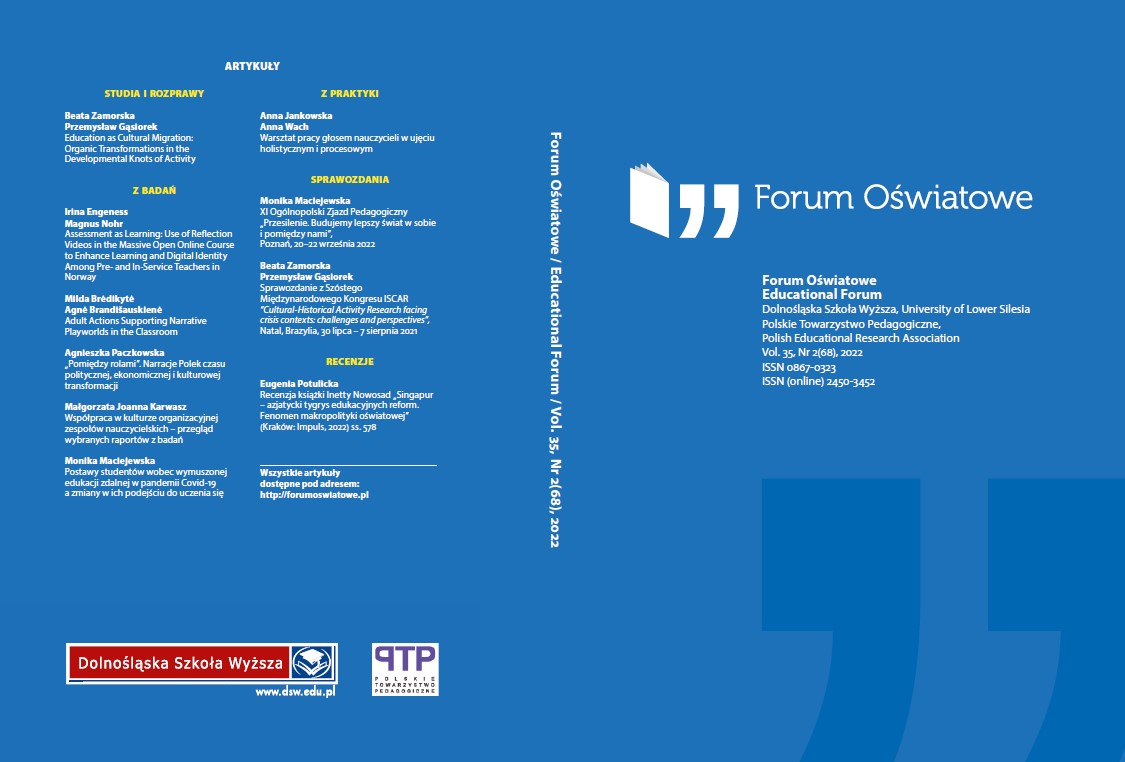
Treść głównego artykułu
Abstrakt
Pomimo wzrastającej atrakcyjności podejścia kulturowo-historycznego, nadal wiele idei Wygotskiego pozostaje nierozpoznanych i niewykorzystanych w praktyce edukacyjnej. Jedną z takich koncepcji jest koncepcja rozwojowych węzłów działalności. W artykule omawiamy proces formowania się węzłów działalności i zachodzących w nich rozwojowych transformacji. Analizowanym przykładem jest wycinek jednej z sesji prowadzonych w klubie młodzieżowym, w którym współpracowaliśmy z nastolatkami zagrożonymi wykluczeniem społecznym. Doświadczyli oni migracji kulturowej, gdy po umieszczeniu w ośrodku wychowawczym musieli odnaleźć się w systemie nowych dla nich relacji społecznych. Analiza zmian zachodzących w procesie zawiązywania węzłów działalności pomiędzy nastolatkami a dorosłym umożliwiła nam zidentyfikowanie właściwości węzłów oraz uwarunkowań, w których nabierają one rozwojowego charakteru.
Słowa kluczowe
Szczegóły artykułu
Prawa autorskie (c) 2022 Forum Oświatowe

Utwór dostępny jest na licencji Creative Commons Uznanie autorstwa – Na tych samych warunkach 4.0 Miedzynarodowe.
Licencja
Osoba publikująca wyraża zgodę na udostępnianie utworu przez Dolnośląską Szkołę Wyższą na licencji Creative Commons Uznanie autorstwa – Na tych samych warunkach 4.0 Międzynarodowe, której pełny tekst dostępny jest na stronie internetowej: https://creativecommons.org/licenses/by-sa/4.0/legalcode
Osoba zgłaszająca upoważniona przez pozostałych współautorów do ich reprezentowania (autor korespondencyjny) zgłoszonego „utworu” oświadcza, że przysługują mu/jej autorskie prawa do utworu, które nie są ograniczone w zakresie objętym niniejszym oświadczeniem.
Utwór jest dziełem oryginalnym i nie narusza praw autorskich innych osób, ani nie jest ograniczony prawami na rzecz osób trzecich.
Utwór nie był wcześniej publikowany pod tym samym lub innym tytułem, nie stanowi również części innej publikacji. Utwór nie jest obecnie przedmiotem postępowania w innym wydawnictwie.
Osoba zgłaszająca utwór do publikacji w czasopiśmie „Forum Oświatowe” i tym samym potwierdza, że:
- Utwór został przygotowany zgodnie z zasadami edytorskimi obowiązującymi w czasopiśmie.
- Utwór zawiera informacje o źródłach finansowania badań, które stanowiły podstawę jego opracowania.
- Wyraża zgodę na przekazanie utworu do podwójnej recenzji, na podstawie której redakcja podejmie decyzję o przyjęciu lub odrzuceniu utworu do publikacji.
- Wyraża zgodę na dokonanie przez redakcję koniecznych zmian utworu wynikających z opracowania redakcyjnego.
- Zobowiązuje się do niezwłocznego dokonania korekty autorskiej utworu, po jego akceptacji przez redakcję. Niedokonanie korekty autorskiej w terminie 14 dni od daty otrzymania materiałów, traktowane będzie za zgodę na wydanie utworu w postaci przekazanej do korekty.
Osoba zgłaszająca udziela Dolnośląskiej Szkole Wyższej nieodpłatnej, nieograniczonej terytorialnie i czasowo nieodpłatnej licencji niewyłącznej na korzystanie z utworu pod warunkiem jego przyjęcia do opublikowania w czasopiśmie „Forum Oświatowe”, na następujących polach eksploatacji:
- Utrwalanie, zwielokrotnianie i wytwarzanie egzemplarzy utworu techniką drukarską, reprograficzną, zapisu magnetycznego oraz techniką cyfrową i zapisu elektronicznego.
- Obrotu oryginałem albo egzemplarzami, na których utwór utrwalono: wprowadzanie do obrotu, sprzedaż, użyczenie lub najem oryginału albo egzemplarzy, publiczne wystawienie, wyświetlenie, a także publiczne udostępnianie utworu w taki sposób, aby każdy mógł mieć do niego dostęp w miejscu i w czasie przez siebie wybranym, również w sieci Internet.
- Włączenie utworu w skład utworu zbiorowego.
- Tłumaczenia na inne języki i rozpowszechniania tych tłumaczeń.
Publikujemy zgodnie z zaleceniami The Committee on Publication Ethics (COPE), w wolnym dostępie na licencji Creative Commons Uznanie autorstwa – Na tych samych warunkach 4.0 Międzynarodowe.
Referencje
- Brushlinskii, A. V. (2004). The Activity Approach and Psychology. Journal of Russian & East European Psychology, 42(2), 69–81. https://doi.org/10.1080/10610405.2004.11059213 DOI: https://doi.org/10.1080/10610405.2004.11059213
- El’konin, B. D. (2001). L.S. Vygotsky and D.B. El’konin. Symbolic Mediation and Joint Action. Journal of Russian & East European Psychology, 39(4), 9–19. https://doi.org/10.2753/RPO1061-040539049 DOI: https://doi.org/10.2753/RPO1061-040539049
- Engeström, Y. (1999). Innovative learning in work teams: Analyzing cycles of knowledge creation in practice. In Y. Engeström, R. Miettinen, & R.-L. Punamäki (Eds.), Perspectives on Activity Theory (1st ed., pp. 377–404). Cambridge University Press. https://doi.org/10.1017/CBO9780511812774.025 DOI: https://doi.org/10.1017/CBO9780511812774.025
- Engeström, Y. (2001). Expansive Learning at Work: Toward an activity theoretical reconceptualization. Journal of Education and Work, 14(1), 133–156. https://doi.org/10.1080/13639080020028747 DOI: https://doi.org/10.1080/13639080020028747
- Engeström, Y. (2008). From Teams to Knots: Activity-Theoretical Studies of Collaboration and Learning at Work. Cambridge University Press. https://doi.org/10.1017/CBO9780511619847 DOI: https://doi.org/10.1017/CBO9780511619847
- Engeström, Y., & Blackler, F. (2005). On the Life of the Object. Organization, 12(3), 307–330. https://doi.org/10.1177/1350508405051268 DOI: https://doi.org/10.1177/1350508405051268
- Fleer, M. (2011). ‘Conceptual Play’: Foregrounding Imagination and Cognition during Concept Formation in Early Years Education. Contemporary Issues in Early Childhood, 12(3), 224–240. https://doi.org/10.2304/ciec.2011.12.3.224 DOI: https://doi.org/10.2304/ciec.2011.12.3.224
- Gołębniak, D. (2021). Ekspansja uczenia się? Co z nauczaniem? W stronę społeczno-kulturowych podstaw edukacji nauczycieli. Wydawnictwo Naukowe DSW.
- Goldsmith, D. F. (2010). The emotional dance of attachment. Clinical Social Work Journal, 38(1), 4–7. DOI: https://doi.org/10.1007/s10615-009-0220-6
- Hakkarainen, P. (2010). Cultural-historical methodology of sutdy of human development in transitions. Cultural-Historical Psychology, 4, 75–81.
- Kukulska, N. (1997, August 11). Im więcej Ciebie tym mniej. https://www.nataliakukulska.pl/component/content/article/20-solowe/sub-solowe/43-puls?Itemid=0
- Leontiev, A. N. (1978). Activity, consciousness, and personality. http://philpapers.org/rec/LEOACA-2
- Leontiev, A. N. (2005). Study of the environment in the pedological works of LS Vygotsky: A critical study. Journal of Russian & East European Psychology, 43(4), 8–28. DOI: https://doi.org/10.1080/10610405.2005.11059254
- Raikes, H. H., Edwards, C. P., & Gandini, L. (2009). Extending the dance in infant and toddler caregiving: Enhancing attachment and relationships. Paul H. Brookes Pub. Co.
- Rubinshtein, S. L. (1989). The Principle of Creative Self-activity (Philosophical Foundations of Modern Pedagogy). Soviet Psychology, 27(2), 6–21. https://doi.org/10.2753/RPO1061-040527026 DOI: https://doi.org/10.2753/RPO1061-040527026
- Sokolova, E. E. (2013). The Dialectical Logic of S.L. Rubinshtein and A.N. Leontiev and the Logical Foundations of Contemporary Psychology’s Network Paradigm. Journal of Russian & East European Psychology, 51(4), 67–93. https://doi.org/10.2753/RPO1061-0405510404 DOI: https://doi.org/10.2753/RPO1061-0405510404
- Spitz, R. A., & Wolf, K. M. (1946). Anaclitic depression; an inquiry into the genesis of psychiatric conditions in early childhood, II. The Psychoanalytic Study of the Child, 2, 313–342. DOI: https://doi.org/10.1080/00797308.1946.11823551
- Tomasello, M. (2014). A natural history of human thinking. Harvard University Press. DOI: https://doi.org/10.4159/9780674726369
- Tomasello, M. (2015). A natural history of human morality. Harvard University Press. DOI: https://doi.org/10.4159/9780674915855
- Tomasello, M. (2019). Becoming human: A theory of ontogeny. The Belknap Press of Harvard University Press. DOI: https://doi.org/10.4159/9780674988651
- Veresov, N. (2010). Forgotten methodology: Vygotsky’s case. In A. Toomela & J. DOI: https://doi.org/10.1108/978-1-60752-432-820251013
- Valsiner (Eds.), Methodological thinking in psychology: 60 years gone astray? (pp. 267–295). Information Age Pub.
- Vygotsky, L. S. (1993). The Collected Works of L.S. Vygotsky: The Fundamentals of Defectology (Abnormal Psychology and Learning Disabilities) (R. W. Rieber & A. S. Carton, Eds.; Vol. 2). Springer US. https://doi.org/10.1007/978-1-4615-2806-7 DOI: https://doi.org/10.1007/978-1-4615-2806-7
- Vygotsky, L. S. (1997a). Consciousness as a problem of behavior. In R. W. Rieber & J. Wollock (Eds.), The Collected Works of L. S. Vygotsky: Problems of the Theory and History of Psychology. Including the Chapter on the Crisis in Psychology (Vol. 3, pp. 63–79). Springer US. https://doi.org/10.1007/978-1-4615-5893-4 DOI: https://doi.org/10.1007/978-1-4615-5893-4
- Vygotsky, L. S. (1997b). Educational psychology. St. Lucie Press.
- Vygotsky, L. S. (1997c). Genesis of Higher Mental Functions. In The Collected Works of L. S. Vygotsky: The History of the Development of Higher Mental Functions. Springer Science & Business Media.
- Vygotsky, L. S. (1999). Tool and Sign In the Development of the Child. In The collected works of L. S. Vygotsky. Scientific legacy (Vol. 6, pp. 3–61). Plenum Press.
- Vygotsky, L. S. (2004). Imagination and Creativity in Childhood. Journal of Russian & East European Psychology, 42(1), 7–97. DOI: https://doi.org/10.1080/10610405.2004.11059210
- Vygotsky, L. S. (2017). The Problem of Teaching and Mental Development at School Age [ Problema obuchenija i umstvennogo razvitija v shkol’nom vozraste ]. Changing English, 24(4), 359–371. https://doi.org/10.1080/1358684X.2017.1395165 DOI: https://doi.org/10.1080/1358684X.2017.1395165
- Vygotsky, L. S. (2019). L. S. Vygotsky’s Pedological Works: Volume 1. Foundations of Pedology. https://doi.org/10.1007/978-981-15-0528-7 DOI: https://doi.org/10.1007/978-981-15-0528-7_1
- Yamazumi, K. (2010). Schools that Contribute to Community Revitalization. In K. Yamazumi (Ed.), Activity theory and fostering learning: Developmental interventions in education and work. Center for Human Activity Theory (CHAT), Kansai University.
- Zuckerman, G. (2007). Child-adult interaction that creates a zone of proximal development. Journal of Russian & East European Psychology, 45(3), 43–69. DOI: https://doi.org/10.2753/RPO1061-0405450302
- Zuckerman, G. (2014). Developmental education. In A. Yasnitsky, R. van der Veer, & M. Ferrari (Eds.), The Cambridge handbook of cultural-historical psychology (pp. 177–202). Cambridge University Press Cambridge. DOI: https://doi.org/10.1017/CBO9781139028097.011
Referencje
Brushlinskii, A. V. (2004). The Activity Approach and Psychology. Journal of Russian & East European Psychology, 42(2), 69–81. https://doi.org/10.1080/10610405.2004.11059213 DOI: https://doi.org/10.1080/10610405.2004.11059213
El’konin, B. D. (2001). L.S. Vygotsky and D.B. El’konin. Symbolic Mediation and Joint Action. Journal of Russian & East European Psychology, 39(4), 9–19. https://doi.org/10.2753/RPO1061-040539049 DOI: https://doi.org/10.2753/RPO1061-040539049
Engeström, Y. (1999). Innovative learning in work teams: Analyzing cycles of knowledge creation in practice. In Y. Engeström, R. Miettinen, & R.-L. Punamäki (Eds.), Perspectives on Activity Theory (1st ed., pp. 377–404). Cambridge University Press. https://doi.org/10.1017/CBO9780511812774.025 DOI: https://doi.org/10.1017/CBO9780511812774.025
Engeström, Y. (2001). Expansive Learning at Work: Toward an activity theoretical reconceptualization. Journal of Education and Work, 14(1), 133–156. https://doi.org/10.1080/13639080020028747 DOI: https://doi.org/10.1080/13639080020028747
Engeström, Y. (2008). From Teams to Knots: Activity-Theoretical Studies of Collaboration and Learning at Work. Cambridge University Press. https://doi.org/10.1017/CBO9780511619847 DOI: https://doi.org/10.1017/CBO9780511619847
Engeström, Y., & Blackler, F. (2005). On the Life of the Object. Organization, 12(3), 307–330. https://doi.org/10.1177/1350508405051268 DOI: https://doi.org/10.1177/1350508405051268
Fleer, M. (2011). ‘Conceptual Play’: Foregrounding Imagination and Cognition during Concept Formation in Early Years Education. Contemporary Issues in Early Childhood, 12(3), 224–240. https://doi.org/10.2304/ciec.2011.12.3.224 DOI: https://doi.org/10.2304/ciec.2011.12.3.224
Gołębniak, D. (2021). Ekspansja uczenia się? Co z nauczaniem? W stronę społeczno-kulturowych podstaw edukacji nauczycieli. Wydawnictwo Naukowe DSW.
Goldsmith, D. F. (2010). The emotional dance of attachment. Clinical Social Work Journal, 38(1), 4–7. DOI: https://doi.org/10.1007/s10615-009-0220-6
Hakkarainen, P. (2010). Cultural-historical methodology of sutdy of human development in transitions. Cultural-Historical Psychology, 4, 75–81.
Kukulska, N. (1997, August 11). Im więcej Ciebie tym mniej. https://www.nataliakukulska.pl/component/content/article/20-solowe/sub-solowe/43-puls?Itemid=0
Leontiev, A. N. (1978). Activity, consciousness, and personality. http://philpapers.org/rec/LEOACA-2
Leontiev, A. N. (2005). Study of the environment in the pedological works of LS Vygotsky: A critical study. Journal of Russian & East European Psychology, 43(4), 8–28. DOI: https://doi.org/10.1080/10610405.2005.11059254
Raikes, H. H., Edwards, C. P., & Gandini, L. (2009). Extending the dance in infant and toddler caregiving: Enhancing attachment and relationships. Paul H. Brookes Pub. Co.
Rubinshtein, S. L. (1989). The Principle of Creative Self-activity (Philosophical Foundations of Modern Pedagogy). Soviet Psychology, 27(2), 6–21. https://doi.org/10.2753/RPO1061-040527026 DOI: https://doi.org/10.2753/RPO1061-040527026
Sokolova, E. E. (2013). The Dialectical Logic of S.L. Rubinshtein and A.N. Leontiev and the Logical Foundations of Contemporary Psychology’s Network Paradigm. Journal of Russian & East European Psychology, 51(4), 67–93. https://doi.org/10.2753/RPO1061-0405510404 DOI: https://doi.org/10.2753/RPO1061-0405510404
Spitz, R. A., & Wolf, K. M. (1946). Anaclitic depression; an inquiry into the genesis of psychiatric conditions in early childhood, II. The Psychoanalytic Study of the Child, 2, 313–342. DOI: https://doi.org/10.1080/00797308.1946.11823551
Tomasello, M. (2014). A natural history of human thinking. Harvard University Press. DOI: https://doi.org/10.4159/9780674726369
Tomasello, M. (2015). A natural history of human morality. Harvard University Press. DOI: https://doi.org/10.4159/9780674915855
Tomasello, M. (2019). Becoming human: A theory of ontogeny. The Belknap Press of Harvard University Press. DOI: https://doi.org/10.4159/9780674988651
Veresov, N. (2010). Forgotten methodology: Vygotsky’s case. In A. Toomela & J. DOI: https://doi.org/10.1108/978-1-60752-432-820251013
Valsiner (Eds.), Methodological thinking in psychology: 60 years gone astray? (pp. 267–295). Information Age Pub.
Vygotsky, L. S. (1993). The Collected Works of L.S. Vygotsky: The Fundamentals of Defectology (Abnormal Psychology and Learning Disabilities) (R. W. Rieber & A. S. Carton, Eds.; Vol. 2). Springer US. https://doi.org/10.1007/978-1-4615-2806-7 DOI: https://doi.org/10.1007/978-1-4615-2806-7
Vygotsky, L. S. (1997a). Consciousness as a problem of behavior. In R. W. Rieber & J. Wollock (Eds.), The Collected Works of L. S. Vygotsky: Problems of the Theory and History of Psychology. Including the Chapter on the Crisis in Psychology (Vol. 3, pp. 63–79). Springer US. https://doi.org/10.1007/978-1-4615-5893-4 DOI: https://doi.org/10.1007/978-1-4615-5893-4
Vygotsky, L. S. (1997b). Educational psychology. St. Lucie Press.
Vygotsky, L. S. (1997c). Genesis of Higher Mental Functions. In The Collected Works of L. S. Vygotsky: The History of the Development of Higher Mental Functions. Springer Science & Business Media.
Vygotsky, L. S. (1999). Tool and Sign In the Development of the Child. In The collected works of L. S. Vygotsky. Scientific legacy (Vol. 6, pp. 3–61). Plenum Press.
Vygotsky, L. S. (2004). Imagination and Creativity in Childhood. Journal of Russian & East European Psychology, 42(1), 7–97. DOI: https://doi.org/10.1080/10610405.2004.11059210
Vygotsky, L. S. (2017). The Problem of Teaching and Mental Development at School Age [ Problema obuchenija i umstvennogo razvitija v shkol’nom vozraste ]. Changing English, 24(4), 359–371. https://doi.org/10.1080/1358684X.2017.1395165 DOI: https://doi.org/10.1080/1358684X.2017.1395165
Vygotsky, L. S. (2019). L. S. Vygotsky’s Pedological Works: Volume 1. Foundations of Pedology. https://doi.org/10.1007/978-981-15-0528-7 DOI: https://doi.org/10.1007/978-981-15-0528-7_1
Yamazumi, K. (2010). Schools that Contribute to Community Revitalization. In K. Yamazumi (Ed.), Activity theory and fostering learning: Developmental interventions in education and work. Center for Human Activity Theory (CHAT), Kansai University.
Zuckerman, G. (2007). Child-adult interaction that creates a zone of proximal development. Journal of Russian & East European Psychology, 45(3), 43–69. DOI: https://doi.org/10.2753/RPO1061-0405450302
Zuckerman, G. (2014). Developmental education. In A. Yasnitsky, R. van der Veer, & M. Ferrari (Eds.), The Cambridge handbook of cultural-historical psychology (pp. 177–202). Cambridge University Press Cambridge. DOI: https://doi.org/10.1017/CBO9781139028097.011